Mar 10 2010

Race Car Fueled by Chocolate

DeBrand Chocolate racecars

Here’s something funny. A race car that is fueled by leftover chocolate. Can’t figure out how there’s any leftover chocolate, but that’s another story. Also I have images of premenstrual women lining up to work as pit crew!

BOSTON (Reuters Life!) – Fueled by leftover chocolate and with components made from carrots, potato starch and flax, the world’s first sustainable Formula 3 racing car has a top speed of 135 miles per hour and can go from zero to 60 in 2.5 seconds.

Sound nuts? Not yet – brake pads made from cashews are still under development.

Meet Lola, the England’s University of Warwick’s blend of muscle and eco-friendliness and the world’s first racing car retrofitted with renewable and sustainable materials.

Researchers from the British university showed off their prize possession at the Massachusetts Institute of Technology’s (MIT) energy conference in Boston.

“She’s incredibly green, taking materials that would otherwise have ended up in a landfill. It lets people engage with recycling without the finger-wagging,” said Kerry Kirwan, one of the car’s designers at the university.

“The public has really taken the car to its heart, because she’s fun,” he said.

Many of the car’s components would more usually be found at a farmer’s market — or in a trash bin, since most of the materials are actually industrial waste.

The 2.0-liter BMW engine has been converted to diesel from gasoline and configured to run on fuel derived from waste from chocolate factories or other plant-based oils.

Among Lola’s other unique features is a radiator that converts ozone back to oxygen.

“It’s a racing car that cleans up as it goes along,” said Steve Maggs, another member of the design team.

The WorldFirst Formula 3 racing car took the university more than nine months to develop and cost around $200,000.

Kirwan said that the thinking behind the project was to find a way to really put recycled materials to the test.

“A lot of these technologies were a huge leap of application, something that shows the material under a really demanding application.”

(Reporting by Ros Krasny; Editing by Patricia Reaney)


Mar 8 2010

Renew Clothing

My daughter Lindsay has the idea that my husband and I can repair anything. She gives Neil her toys and I get her clothing. We usually are able to fix her things in a way that works for her. Cute patches on knees of jeans, etc. Neil jokes about starting a company called “Made in China, Repaired in Brooklyn.” I like that Lindsay likes us to repair items, rather than tossing them out.

I just read Lyanda’s The Tangled Nest  post about patching a favorite pair of pants. Lyanda is the author of a lovely book called Crow Planet, which I will write about soon. (It’s been in my reading list on the sidebar here for ages) She calls me her East coast soul sister and I think she’s right. In her blog post, she asks people to write about things they have creatively rescued. Many posts were about people taking old large-sized clothing to turn into new small-sized garments. It made me think of a blog that was devoted to just that. And I can’t think of the blasted name of that blog. They asked people to take a pledge not to buy new clothing, and instead bring new life to their existing wardrobe. They had great ideas for converting t-shirts and other things into pretty hip new garments. Somebody please help me with the name of this blog.

So while I was searching for the blog online, I came across this article in NYU News about Project Design, which is a program designed to teach low-income women how to reclaim used/vintage clothing. They teach the young women how to design, sew, etc. Take a peek at the article. It is a really nice idea.


Mar 6 2010

Making Brooklyn Bloom

Here’s a Brooklyn Eagle article giving information about an event at the Brooklyn Botanic Gardens.

BROOKLYN — The urban gardening community will kick off the spring gardening season at Brooklyn Botanic Garden (BBG) with the 29th annual Making Brooklyn Bloom, a daylong conference on how to green up the borough.

It will be presented on Saturday, March 13, by GreenBridge, the community environmental horticulture program at Brooklyn Botanic Garden.

This year’s Making Brooklyn Bloom, “Soil in the City: Growing Healthy Neighborhoods from the Ground Up,” will focus on revitalizing our soil, the foundation of life in the garden. The free event features a keynote address by Dr. Nina Bassuk, director of the Urban Horticulture Institute at Cornell University, developer of Cornell Structural Soil, and author of Trees in the Urban Landscape.

Exhibits and workshops on rooftop farming, community composting, and soil testing will be offered—all presented by members of BBG’s horticulture staff or experts from other greening organizations in New York City.

“For 29 years, Making Brooklyn Bloom has introduced urban gardeners to sustainable practices and encouraged ecological awareness in city gardens—whether those gardens are on windowsills, in backyards, or in community gardens,” says Robin Simmen, director of GreenBridge.

“Focusing on soil this year addresses an issue that pertains to everyone interested in cultivating green space in the city. GreenBridge is proud to bring together leaders in sustainable horticulture and environmental science to share their knowledge on this critical issue—and in doing so, strengthen the community of Brooklyn gardeners,” she adds.

To celebrate its centennial, BBG is commemorating the renewal of Brooklyn’s urban environment by sharing before-and-after photos of local community gardens.

Attendees are encouraged to bring photos of their gardens on the day of the event; BBG staff will be on hand to scan and share them on the web throughout our centennial year. Like many of Brooklyn’s gardens, BBG itself started from scratch, transforming its grounds from a derelict coal ash dump into an emerald gem in the heart of the borough.

For more details on Making Brooklyn Bloom, please call (718) 623-7250 or visit bbg.org/vis2/2010/mbb/.


Mar 4 2010

Brooklyn Hawk

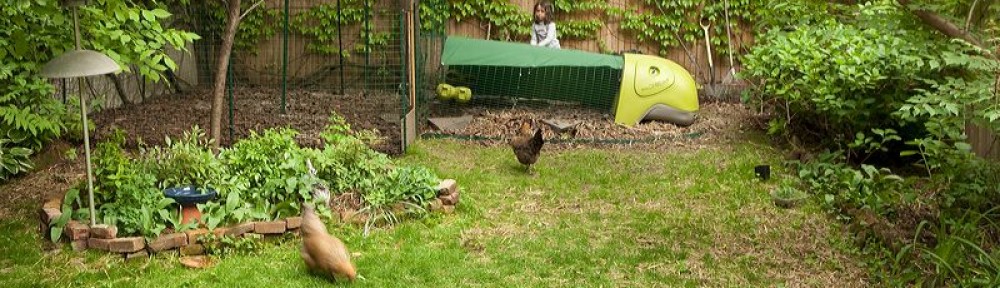
Over the weekend, Neil looked out our kitchen window and spotted this beautiful hawk. It has visited our backyard before and it is always very special to see such a glorious bird here in the city. It generally sits in this tree, which grows above our chicken coop. Fortunately this time the hawk was too engrossed with the pigeon it was eating to notice the chickens. Conversely, the chickens were still in their covered run, so they didn’t see the predator sitting right over them. You can see what’s left of the pigeon on the branch the hawk is sitting on.

We have friends who live right around the corner from us who have seen and named this hawk (Hank). They have a view of our yard from their apartment, so I called them and helped them to spot the hawk. We live along a street that became a restaurant row about 10 years ago. It’s been interesting to see how the abundance of food has affected the natural world in our neighborhood. We first started noticing rodents. Sigh. Then we got raccoons. And now we have hawks feasting on the vermin that’s been attracted to the area. I was very happy to see the hawk eating a pigeon. Hopefully our friend decides to hang around.


Mar 1 2010

Snowy Weekend

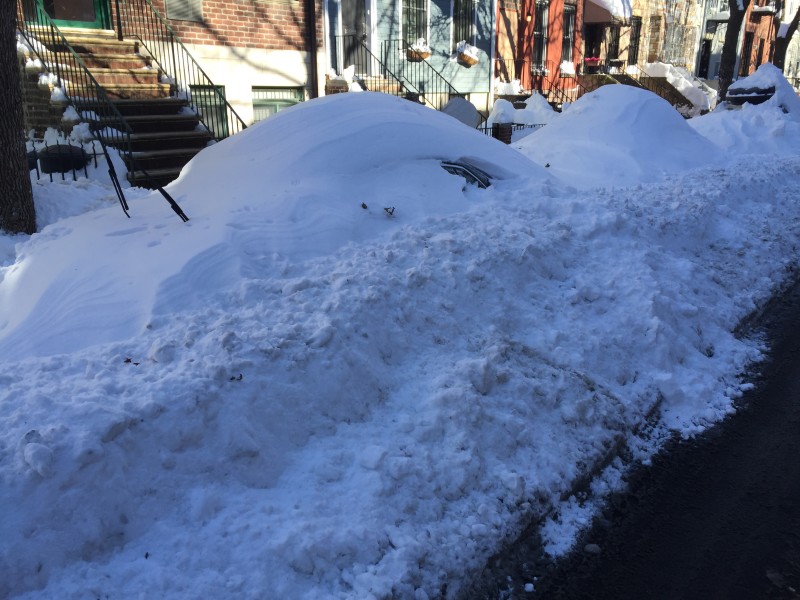
This weekend turned out to be a 3-day weekend with Lindsay getting a snow day on Friday. Thursday was weird snowy, slush, which turned to snow during the night. When we woke up on Friday, we had over a foot of snow.

We stayed in the immediate neighborhood and played in the snow. It’s fun going down the street in a sled. It makes the grown-ups who are trudging off to work, break out of their funk and smile. It’s good to be a kid!

While Lindsay was playing, I made this little snow kid.


Feb 26 2010

How to keep your chickens warm in the winter

A lot of people wonder what I do with my chickens in the winter. Don’t they get cold? My short answer is that they stay warm because they wear little down coats. My long answer is that it is more the cold wind/draft that bothers them more than the cold.

Neil wrapped a plastic tarp over the open (wire) part of the run. The green part is insulated and even has a little door that I can close. If the temperature drops below about 25 degrees F, I will close the little door at night. They generate enough body heat to keep themselves warm.

During the day they walk around in the covered run, which is kind of like a mini-greenhouse. I open the door to the extended run, so they can decide if they want to brave the elements or not.

I also have an electric water dispenser, which keeps their water from freezing. But that’s basically it. I don’t heat the coop and I haven’t knitted them little sweaters. I don’t put vaseline on their legs and combs to prevent frostbite. I would do that if I lived somewhere *much* colder, but it’s never been a problem here.

Call me what you will, but I don’t think we need to extend helicopter parenting to our chickens.


Feb 25 2010

No more Hummers

GM has announced that they will stop production of the gas guzzling Hummer. The bad news is that about 3,000 jobs may be lost. The good news is that maybe people in the US (and China, since they backed out of a deal to buy Hummer) are realizing that we are experiencing an environmental crisis and want to do something to change it.

Hopefully GM will work harder to make fuel-efficient cars for us now. My fingers are crossed.


Feb 16 2010

High Fructose Corn Syrup Ad Campaign

When I was a kid I loved to stay up late and watch Saturday Night Live. I was usually pretty tired because it was way past my bedtime. It was always a bit unsettling when I was watching what I thought was a real commercial only to realize it was a spoof that was part of the show. That is how I felt the other night when I was watching tv and there was a pro-high-fructose corn syrup (hfcs) commercial. Unfortunately Neil wasn’t home, so I didn’t have anyone to turn to and scream, “Did you just see that??”

The video above is one of the commercials the Corn Refiners Association is running on tv. They have spent 30 million dollars launching this pro-HFCS campaign.

I find the commercials disturbing because of course they appeal to morons, who haven’t read anything about food in the past 20 years. But I also think it’s a good sign that the corn refiners must be getting hit  with bad press. Otherwise they would never have coughed up $30 million.

Just in case you are like the woman in the video and can’t think of reasons why HF Corn Syrup is bad, click here for 4 very good reasons to avoid it.


Feb 14 2010

Linzer Torte and my dad

Of the many things my father loved to do, bake and listen to Mozart ranked very high. Whenever he had friends or family over to the house he loved to bake a special treat for them. He had an endless supply of  Hungarian recipes that he would try. His success rate was about 70% and when the desserts were good, they were really wonderful. The 30% failure rate usually had to do with his not thinking he had to follow a baking recipe to the letter. “Why should I put salt in something that’s sweet” was something he firmly believed. I am still scared to glaze a dessert with egg whites. My sister will immediately know why. My father must not have beaten his egg whites enough and one time his linzer torte came out with the equivalent of an egg white omelet on top of it. We had to scrape the omelet off the top and eat it because it was a crime to waste food in our house.

My father got better and better with his baking and all of his friends loved to share his creations. My father particularly loved to bake with my sister and me. It was a nice time that we could spend together.

One year ago friday my father passed away. I was thinking of a way to spend the day remembering him. I decided to listen to Mozart and make a linzer torte. Linzer was one of his favorite recipes and he seemed to have a different recipe every time he made it.

Linzer Torte Recipe

3 1/2 c. flour

1/2 c. sugar

1 generous T. baking powder

2 sticks of softened butter

1 egg yolk

1/4 c. sour cream (I felt like a bad Hungarian girl because I didn’t have any sour cream in the fridge)

1 grated lemon peel

juice from 1 lemon

jar of thick jam (raspberry, apricot or red currant)

1 1/2 c. finely chopped walnuts

1 egg white (please beat this well, or you will end up with the dreaded omelet on top)

Combine dry ingredients. Add butter. Combine and make a well in center.

Mix together the wet ingredients (except the egg white) and add to the flour mixture. Divide dough in 1/2. Press 1/2 the dough into the bottom of a 10×15 baking pan. Refrigerate both halves for an hour or overnight if desired.

Spread the jam onto the dough in the pan, making sure you don’t go all the way to the edge. It will burn if you do. I try and get as close as possible, because it can be a little bit dry otherwise.

Sprinkle the nuts over the jam.

Roll the remaining dough into ropes about 1/2″ in diameter. Think back to your preschool days when you would make snakes out of playdoh and you’ll get the idea.

I was running out of time and the dough wasn’t cooperating, so I rolled it out with a rolling pin and just cut strips. It worked really well, but next time I would try and roll the strip to make it a little rounder and more attractive. I also didn’t have time to make a nice woven lattice, but that would have been much prettier.

Once you have the top done, brush the egg white on top to make a nice glaze. Or you can skip this step if I’ve scared you.

Bake at 350F for 30-35 minutes or until the crust has a golden brown color.


Feb 9 2010

We’ve Moved!

The New Green Blog has now become Brooklyn Feed. You might have noticed that you were automatically redirected. I think the program might even have updated your bookmark (I don’t even pretend to understand this technology!). But just in case it didn’t, please change your bookmark to come here directly.

Thanks!